
How the experience developed
Spotify’s official retrospective identifies a 2015 Year in Music experience, the 2016 change to the Wrapped name, and the move into the Spotify app in 2019. This was an evolving product and campaign, not a single social post. The account describes a collaborative effort rather than establishing one person as the sole inventor. Read Spotify’s timeline.
The idea at a glance
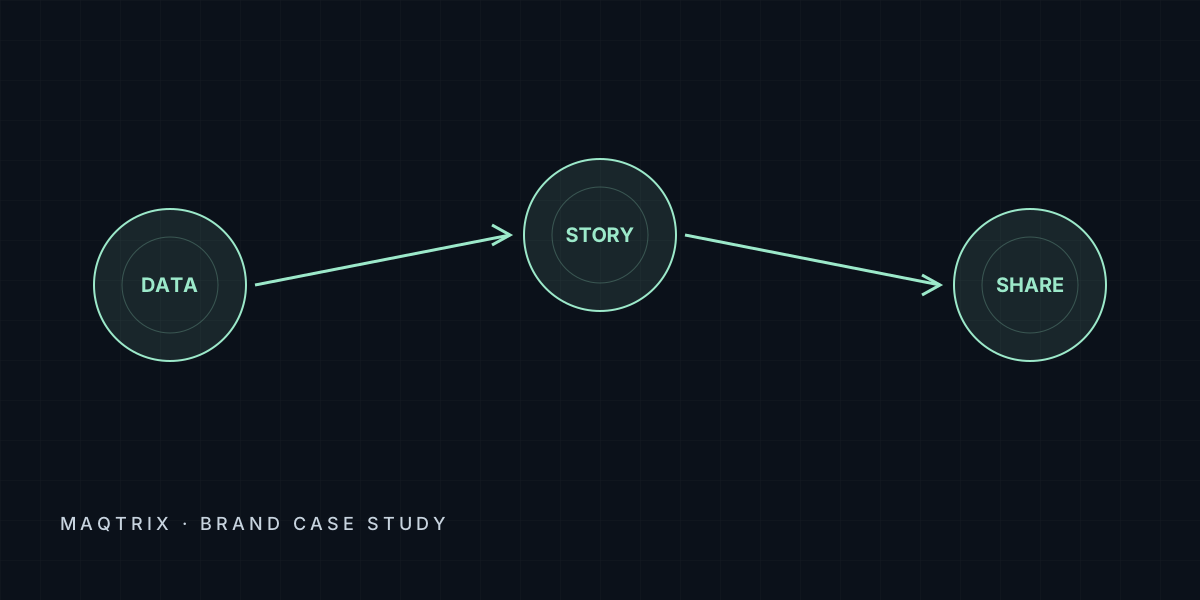
The reported number—and its limit
Spotify reports that Wrapped engaged 227 million monthly active users in 2023. That is a company-reported engagement figure. It is not 227 million new customers, paid subscriptions or social shares, and it does not establish incremental revenue attributable to Wrapped. Spotify’s retrospective.
A smaller business should not adopt that scale as a target. The more useful question is whether a recap helps an existing customer understand their experience and gives them something they might voluntarily want to keep or share.
Our interpretation: the customer becomes the subject
A standard report describes the company’s activity. A personal recap can describe something the customer recognises about themselves: what they explored, completed or enjoyed. That shift can make the material more relevant than a generic brand announcement.
Sharing may express identity, invite comparison or simply entertain friends. These are plausible interpretations, not experimentally isolated explanations for Wrapped’s results. Do not assume that every customer wants a public story about their behaviour.
Three layers of a useful recap
The record: accurate observations with a clear period and definition. The meaning: a short explanation of why the observations matter to that person. The next step: a useful recommendation or optional sharing format.
For example, “You completed four planning sessions” is an activity record. “You now have an agreed campaign brief” describes a completed output, if true. “Your revenue grew because of those sessions” is a causal claim requiring much stronger evidence. A visually exciting recap should not blur these layers.
Data quality and privacy are part of the creative work
Missing records, duplicate events and shared accounts can distort a personal recap. Explain what is measured and what is excluded. Do not call a partial period a full year or give someone a percentile without a valid comparison group.
Prepare a private version before a shareable one. Remove financial details, customer names, addresses and confidential project information from public cards. Let the customer review the content and choose what to share. A completed service does not itself authorise a public testimonial.
How to apply it in your business
This is an original Maqtrix workflow to test. It is not a procedure proven by the cited study or a claim about results we have delivered.
1. Choose a meaningful period
Use a completed project, a quarter or another period the customer recognises. State the start and end dates. Avoid filling a sparse report with arbitrary rankings merely to make it look like a large platform’s annual campaign.
2. Audit the underlying records
Check that each event belongs to the right customer and that repeated entries are not counted twice. Document the unit: a visit, completed task, delivered file or approved milestone. Keep a source record for every displayed number.
3. Select three useful observations
Choose facts that help the customer understand progress or preferences. A photography client might see event segments covered and delivered collections. A marketing client might see completed experiments and lessons. Avoid substituting activity counts for commercial outcomes.
4. Add interpretation carefully
Explain one pattern and one useful next step. Label hypotheses as hypotheses. If a campaign produced enquiries but sales attribution is incomplete, say so. A concise limitation can make a report more useful than a confident but unsupported conclusion.
5. Design for private reading first
Make the recap readable on a phone, with plain labels and a short explanation of the data period. Give the customer a route to correct errors. Do not require public sharing to receive their own report.
6. Create an optional public version
Offer a smaller card with only approved, non-confidential facts. Let the customer edit or decline. Keep the brand signature modest so the card is about the customer’s experience rather than an advertisement they are being asked to distribute.
7. Measure the recap’s usefulness
Track whether customers open it, understand it and use the next step. Measure voluntary sharing separately. If the recap is useful privately but rarely shared, that may still be a good outcome for a service business.
A practical service-business example
Hypothetical Maqtrix recap: “This month we tested two messages, repaired the enquiry path and identified the questions prospects ask most often.” Each statement would link to the actual work or records. A separate section would report verified enquiries and explain any measurement gaps.
The client could choose to share a simple milestone card after reviewing it. We would not publish their campaign spend or claim a revenue improvement without evidence and permission. The recap should help the client decide what to do next even if it never reaches social media.
What to measure
| Measure | What to record |
|---|---|
| Coverage | Customers with enough reliable records for a meaningful recap. |
| Understanding | Whether readers can identify the period, key result and next action. |
| Voluntary engagement | Recap opens, useful replies and approved shares, each reported separately. |
| Retention evidence | Renewal or return behaviour with a clear comparison; do not infer causation from recipients alone. |
Define the outcome and observation period before launching. Where volume allows, compare randomly assigned, comparable groups and keep other changes limited. With a small customer base, begin with a usability pilot and report the actual counts. A before-and-after change is useful to investigate, but it does not by itself prove causation.
Use the first-party measurement guide to plan the records, and the campaign brief template to document the test.
Common questions
Who invented Spotify Wrapped?
The official history describes an evolving programme and collaborative work. This page does not attribute sole invention to one person.
Do we need a large customer database?
No. A manually checked project recap can be useful. Start with a few accurate facts rather than a complex automated ranking.
Can we turn every client result into a social card?
Only where the facts are verified and the client agrees to the public content. Keep a private report available regardless.
Original sources and research notes
Researched October 7, 2026. Historical claims and findings are linked to the sources below. Company accounts are labelled as such. Business workflows, examples and interpretations are Maqtrix’s proposals, not independently established performance outcomes.
- Spotify, December 4, 2024: A Decade of Spotify WrappedOfficial retrospective: Year in Music, Wrapped naming, in-app delivery and 2023 engagement.
Named brands and researchers are discussed for educational analysis. No affiliation or endorsement is implied.
Continue exploring
Turn the idea into a useful test
Choose one customer decision you want to make clearer. Email us with your business, the current problem and the change you are considering.
Start an email enquiry →