
What actually changed?
In December 2009, Domino’s announced a new core hand-tossed pizza recipe: changes to the crust, sauce and cheese, with rollout to all U.S. stores beginning December 27. Its announcement connected the redesign to customer feedback and testing. The change was a product decision supported by marketing. Read the original announcement.
The important business question is whether your message describes a better experience customers can actually receive. Admitting a weakness can get attention; a visible correction gives people a reason to try again.
The idea at a glance
Who was responsible—and when?
The launch announcement names David A. Brandon as chairman and CEO and Russell Weiner as chief marketing officer. The following year’s results quote J. Patrick Doyle as president and CEO. Those roles changed across the turnaround period; attributing the entire programme to one person would lose the contribution of product, research, marketing and store teams. 2009 launch · 2010 results.
The reported result, with the right denominator
Domino’s reported 9.9% domestic same-store sales growth for fiscal 2010. Management attributed the performance to store traffic, response to the improved pizza and advertising. Same-store sales compare stores operating in both relevant periods; this is not a 9.9% advertising conversion rate, profit increase or global sales figure. Financial release and metric definitions.
The release is primary business evidence, but it is the company’s own account. It does not isolate how much came from the recipe, promotion, distribution, media spend or other changes. A before-and-after business result cannot identify the causal contribution of one creative idea.
The psychology: make reconsideration reasonable
Our interpretation is that a specific correction can reduce the uncertainty around trying a brand again. “We are better” asks a customer to trust an adjective. “Here is the problem we found, the change we made and how you can assess it” gives them a decision process.
There is also a distinction between acknowledging criticism and repeating it for entertainment. If a service business publicises complaints without fixing delivery, it can remind prospective clients of the reason to avoid it. The story must be proportionate to the improvement.
Why copying the apology can fail
A national restaurant brand had scale, existing awareness and an operating network. A small business cannot assume that a similarly candid video will reproduce its results. Your main problem may be visibility rather than product dissatisfaction.
Start with evidence of a recurring problem. Do not manufacture a past failure to make a dramatic comeback story. Do not use customer names, private complaints or before-and-after testimonials without permission. If a promise depends on staff behaviour, the team needs the tools and capacity to deliver it consistently.
How to apply it in your business
This is an original Maqtrix workflow to test. It is not a procedure proven by the cited study or a claim about results we have delivered.
1. Gather the real complaint
Read support requests, cancellations and customer interviews. Sort them into product quality, delivery, communication and expectation problems. Count recurrence rather than choosing only the most colourful quote. Ask customers what a satisfactory correction would look like.
2. Select a problem you can fix
Choose one meaningful failure within your control. For an agency, it might be unclear reporting or slow project handoffs. Write a measurable standard such as a named owner and a scheduled review, rather than promising that every campaign will succeed.
3. Change the operation first
Create the new process, train the responsible person and run it on a small pilot. Record where it still fails. If the process depends on the founder rescuing every task, it is not ready for a broad public promise.
4. Build an evidence package
Prepare an example of the revised output, an explanation of what changed and a way for customers to evaluate it. Use real documents with confidential material removed. Label demonstrations as demonstrations; do not turn a sample into a claimed client result.
5. Explain the correction plainly
Use a short sequence: what customers needed, what you changed, what they can now expect and how to try it. Avoid self-congratulation. Acknowledge what is still outside the scope so the new campaign does not create another expectation gap.
6. Invite a low-pressure reassessment
Offer an appropriate demonstration or conversation. Former customers should be able to decline. Ask participants to evaluate the changed feature specifically; general praise is less useful than knowing whether the original problem was resolved.
7. Monitor repeat behaviour
Look beyond launch attention. Check whether trial customers return, whether complaints recur and whether the new process remains affordable. Continue collecting negative feedback after publishing the success story.
A practical service-business example
Hypothetical service example: a photography business learns that customers like the images but cannot find the files they need. It reorganises galleries by event segment, adds a short handover guide and tests the system with customers before advertising “easier delivery.” The proof is successful retrieval and fewer support requests—not a dramatic apology film.
At Maqtrix, the equivalent would be improving a confusing report before promoting clearer reporting. A sample report can show the format; only actual client evidence can substantiate a claim about better decisions or business performance.
What to measure
| Measure | What to record |
|---|---|
| Resolved problem | Repeat complaint rate among customers who experienced the revised process. |
| Trial-to-repeat | Customers who return within a defined window ÷ eligible trial customers. |
| Operational consistency | Percentage of deliveries meeting the new standard. |
| Economics | Cost of rework, delivery time and contribution per completed engagement. |
Define the outcome and observation period before launching. Where volume allows, compare randomly assigned, comparable groups and keep other changes limited. With a small customer base, begin with a usability pilot and report the actual counts. A before-and-after change is useful to investigate, but it does not by itself prove causation.
Use the first-party measurement guide to plan the records, and the campaign brief template to document the test.
Common questions
Did the advertising alone cause the turnaround?
The financial release does not establish that. Product changes and advertising happened together, alongside other business activity.
Should a small business publicly admit every problem?
Address a verified, relevant issue with a real remedy. Private customer matters and unresolved operational problems need careful handling rather than a promotional reveal.
What can we copy immediately?
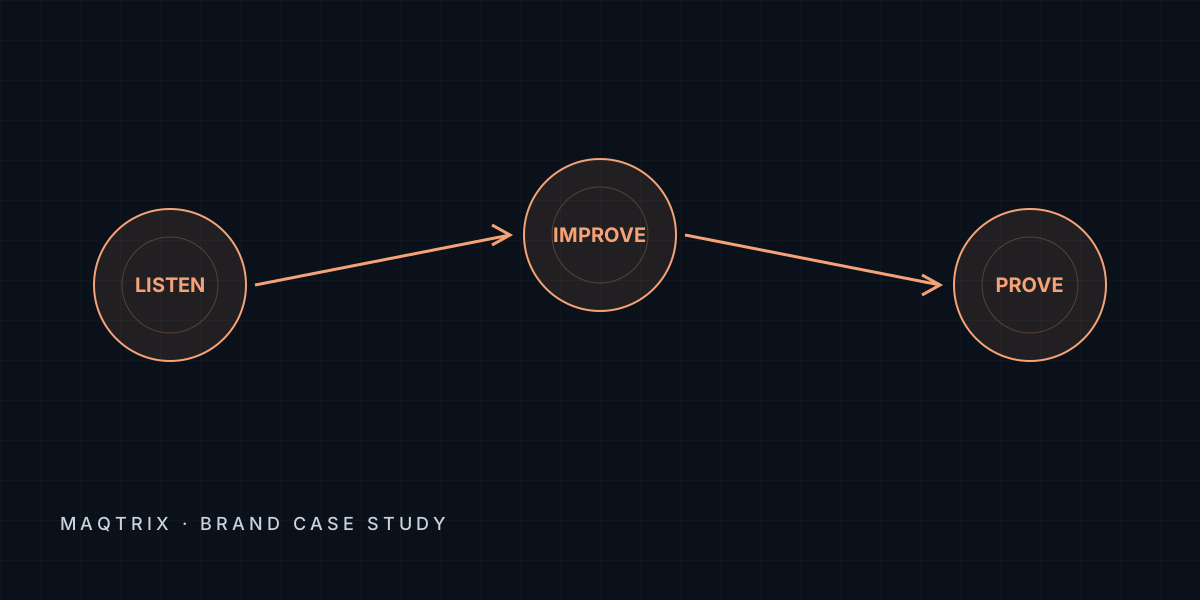
The sequence: listen, fix, demonstrate, invite reassessment and measure repeat use. The specific sales result is not transferable.
Original sources and research notes
Researched October 7, 2026. Historical claims and findings are linked to the sources below. Company accounts are labelled as such. Business workflows, examples and interpretations are Maqtrix’s proposals, not independently established performance outcomes.
- Domino’s, December 16, 2009: new pizza announcementContemporaneous company announcement of recipe changes, consumer research and rollout.
- Domino’s, March 1, 2011: 2010 financial resultsCompany-reported domestic same-store sales; not an isolated advertising experiment.
Named brands and researchers are discussed for educational analysis. No affiliation or endorsement is implied.
Continue exploring
Turn the idea into a useful test
Choose one customer decision you want to make clearer. Email us with your business, the current problem and the change you are considering.
Start an email enquiry →